For years, Shirley spent 11 hours a day on a dialysis machine. As someone living with an autoimmune condition that affected her kidneys, she knew that dialysis wasn’t something she could manage long-term, and it was impacting her quality of life. Her options were limited and conversations were being held about what to do next.
Then one day, all of that changed, thanks to a lifesaving gift from her daughter.
This is Shirley’s story.
Shirley's health journey
Shirley's kidney journey started decades ago. A retired educator and three-time cancer survivor, she was diagnosed with focal segmental glomerulosclerosis (FSGS), an autoimmune condition that scars the glomeruli, which are the tiny filtering units inside the kidney that are responsible for cleaning the blood.
"It's a slow-moving condition," Shirley said. "There's no cure and not a lot they can do with it, short of steroid treatment and other medications. The side effects of long-term use of those aren't good."
For years, a nephrologist monitored her numbers, watching her kidney function slowly decline with no real way to stop it. Her kidney function eventually dropped into the 20% range. This was the point where her nephrologist initiated the conversation about what comes next.
Shirley started with in-center hemodialysis, a treatment where a machine removes waste products, extra salt and fluid from the blood, but her body couldn't tolerate it. Her blood pressure crashed and she was hospitalized more than once.
"The impact on my heart was not good," Shirley said. "It was very hard on my body, and for me, it was pretty terrible."
She switched to peritoneal dialysis, which she could do overnight at home. It was gentler, but it came with its own cost. Every night, it took Shirley 30 minutes to set up, 10 hours connected to the machine, and another 30 minutes to disconnect and clean up. It equated to about 11 hours of her day, every day, for three years.
"It was energy-zapping, for sure," she said. "My skin changed colors; all the things that go with longer-term dialysis were part of my everyday."
Twice disqualified from the transplant list
About two years into dialysis, Shirley began asking about a kidney transplant. She was initially disqualified from the transplant list because of her heart. She spent time working with a cardiologist, got a pacemaker, underwent heart catheterizations and adjusted her medications until her heart function improved enough to qualify.
But the medications that helped her heart also dropped her blood pressure, sometimes low enough to the point that she passed out. During one episode, she fell in a hallway and hit the floor hard, breaking her femur, which then required a hip replacement.
That injury disqualified her from the transplant list a second time. Before she could re-qualify, she had to prove her hip had healed, that her blood pressure had stabilized and had stopped passing out, and that she could function independently again.
It took about two years of work to get approved. Once she finally made the list, her transplant team gave her the standard timeline: three to five years before a deceased-donor kidney would likely become available. This was in line with national data of the typical wait for a deceased-donor kidney in the United States today.
Shirley has two daughters, and both of them volunteered to get tested to see if either was a match. Ultimately, it was Jennifer who turned out to be a match for her mother. The family found out just before Christmas 2025, and after consulting with their medical team, they set the date for Shirley’s kidney transplant for January 2026.
"I always say Jennifer either won or lost, I don't know which one," Shirley said.
On January 30, 2026, Shirley’s wait for a new kidney ended. In an operating room at Baylor University Medical Center, part of Baylor Scott & White Health, surgeons removed a kidney from Jennifer and placed it into Shirley.
"My daughter’s kidney is a superstar," Shirley said.
Why Jennifer said yes to donating her kidney
Jennifer didn't need much convincing about donating one of her kidneys to her mother. She'd spent years watching her mother navigate diet restrictions, medication schedules, hospital stays and the daily grind of home dialysis. When Shirley broke her hip, Jennifer saw firsthand what dialysis at home really looked like for her mother.
"I watched her struggle," Jennifer said. "I felt like I needed to be tested to see if I was a match, and I would honestly have felt a little guilty if I didn't."
That doesn't mean it was an easy decision emotionally once she found out she was a match for her mother. Jennifer was a new mother herself, with a young daughter, and she was candid about the anxiety that came with signing up for major surgery.
Shirley reminded her more than once that she could back out if she had second thoughts. The transplant team also told her that living donors always have that option, with protections in place if they choose it.
"I had one night where I completely freaked out about it," Jennifer said. Using the risk information and statistics her medical team had given her about donation and living with one kidney, she compiled a list of pros and cons. "After reviewing the options, I felt very convinced that I needed to do this."
Shirley carried her own version of that mental weight, but from the other direction.
"I was coming at it from a different perspective, with my own daughter being my donor," she said. "I knew I was impacting her life, and possibly not in a positive way. That's something that no mother ever wants to do."
Even now, when Jennifer skips something strenuous because it doesn't feel right post-surgery, Shirley notices. "It weighs on me," she admitted. "What happens if something happens to her remaining healthy kidney?"
It's a conflict that lives at the heart of living donation, a parent's instinct to protect a child, set against a child's determination to save a parent. But in Shirley's and Jennifer’s family, love won out on both sides.
A moment not to be forgotten
Shirley remembers the day of her transplant surgery in vivid detail because she was still awake for the start of it. Jennifer went into the operating room first. Shirley waited for what “seemed like a thousand years” while doctors examined Jennifer’s donated kidney.
When Shirley was finally wheeled into her own operating room, she saw the surgeon standing behind a table, holding something in her hands. It was Jennifer's kidney. "I'm so glad I hadn't been put under yet," Shirley said. "I can remember that as being just amazing, seeing her holding Jennifer’s kidney in her hand as she was inspecting it."
The recovery that followed her kidney transplant surprised even Shirley. Surgery was on a Friday and she was discharged the following Tuesday, already walking well, out of pain and able to eat normally.
Her oldest daughter stayed with her that first week, driving her to follow-up checkups and lab appointments, all of which came back looking good.
The biggest change was one Shirley had almost forgotten existed—getting up in the night to use the bathroom, something dialysis had made rare for three years. "That was actually wonderful," Shirley said. "My new kidney was definitely working!"
Within a few weeks, she was cleared to drive herself to appointments and manage her own daily routine again, walking around and eating whatever she wanted, which felt like its own kind of celebration after years of strict dietary limits.
Jennifer's recovery had its own rhythm. She spent two days in the hospital and leaned on her partner to help care for her daughter while she healed. She lost some muscle mass, which she'd expected, but was committed to keeping up the healthier habits she had adopted before surgery.
Life post-kidney transplant
Six months later, Shirley is back to eating her favorite foods, driving herself to appointments and living what she calls "a pretty awesome" life. Jennifer is back to chasing her young child around the house, working full-time and gearing up to return to her passion as a singer in a local band.
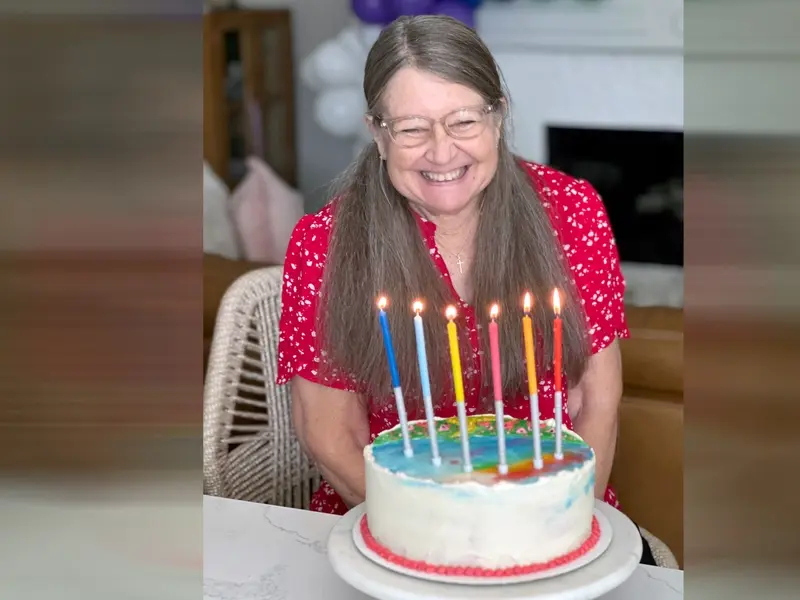
This is the kind of outcome that living kidney donation makes possible, and their story is a glimpse into what that gift looks like, both physically and mentally.
Both women describe their lives now in strikingly ordinary terms, which, after years of dialysis and major surgery, is exactly the point.
Shirley recently saw her nephrologist and got good news across the board.
"I'm 71 now, and I don't quite jump off the walls with a ton of energy, but I feel good," she said.
She occasionally feels little twinges of discomfort, which her doctors explained are nerve endings firing in scar tissue rather than anything related to the kidney itself. She still paces herself and rests more often when she's overdone it. She's savoring the small things that weren’t possible years ago, like enjoying avocados and nuts, foods that used to send her potassium levels soaring on dialysis.
"I can do what I want to. My life is really pretty awesome right now," Shirley said.
Jennifer also feels the same nerve-ending twinges her mother describes. She's able to lift her daughter again and is back at her full-time job, where her employer has been incredibly supportive throughout the process. She’s also closing in on a return to the stage with her band. "I feel pretty normal," she said. "I'm not back singing onstage yet, but soon."
A story that came full circle
Years after receiving a kidney from her mother, one daughter had the chance to return the gift. Watch their inspiring story.
Watch their story →
A message for anyone considering living organ donation
Both women had something they wanted other families to hear about what they’ve experienced on this journey.
For Shirley, it's about persistence through the hardest stretch. "Dialysis is hard," she said. "There are so many days you think it is just not worth it. But don't give up. Keep striving toward that transplant. People say to me that I look better. I feel better. I'm so glad I didn't give up."
For Jennifer, it's a case for considering living donation, even if it’s outside your own family.
"By donating, you can give someone the gift of life, and that's a very rare opportunity," she said. "In my situation, it makes it different because it's my mother; she gave me life. But for anyone considering it, even though it may not be your mom or someone you're even related to, you are still giving someone the ultimate gift."
The bigger picture of kidney donation
Shirley's and Jennifer’s story is remarkable, but the need behind it is not rare. According to Donate Life America, more than 90,000 people in the US are currently waiting for a kidney, and 86% of everyone on the national transplant waiting list is waiting for a kidney specifically. A deceased-donor kidney typically takes three to five years to become available, but a living donor, like Jennifer, can cut that wait dramatically, sometimes to a year or less.
Living donors go through extensive medical and psychological screening before they're approved, and they retain the right to change their minds at any point in the process. Most go on to live full, healthy lives.
Shirley and Jennifer's story is proof of what the gift of organ donation means in practice, a family with one more reason to believe in the power of saying yes.
Learn more about the kidney transplant program at Baylor Scott & White Health or explore what it means to become a living donor.