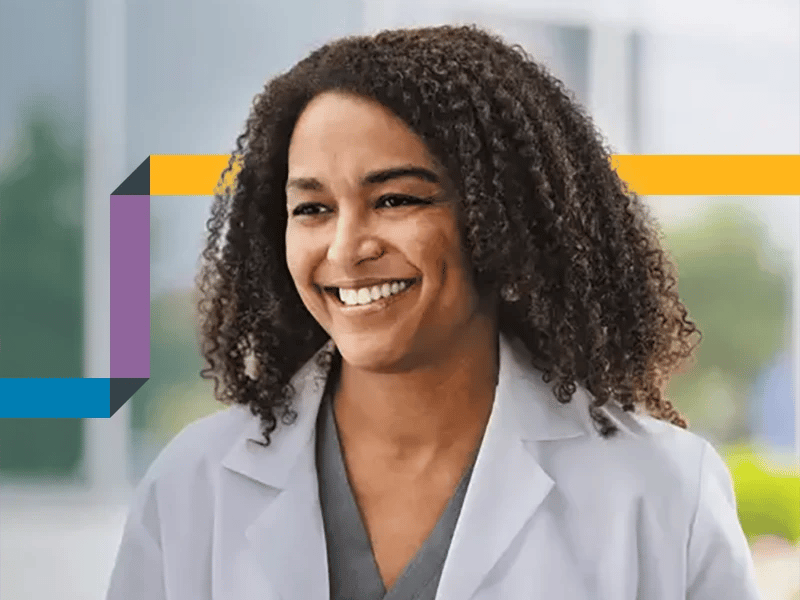
This story is told by Gabriel Mira, the husband of Melissa Mira, a heart transplant recipient at Baylor University Medical Center, part of Baylor Scott & White Health.
I don’t use the word “miracle” lightly. But as I look back on what my wife has been through, it’s hard not to think about how many times things turned in a direction we didn’t expect.
Her name is Melissa. She’s 41 years old, and she’s someone who has faced more than most people ever will. This is one chapter of her story—her journey to a heart transplant and the long road to recovery afterward.
Melissa’s story begins
Melissa’s story doesn't begin in the summer of 2025. It begins when Melissa was six or seven years old and her mom noticed she kept running out of breath. What they found when they took her to the hospital was a tumor in her chest the size of a football. She was diagnosed with Ewing’s sarcoma, a rare and aggressive form of cancer that develops in bones or the soft tissue surrounding them, and in Melissa’s case, the chest wall.
She went through intensive treatment, including chemotherapy. She went into remission and, over time, returned to a full life.
Years later, doctors would have different opinions about whether those early treatments contributed to her later heart condition. What they all agreed on was this: Melissa shouldn't have recovered as well as she did.
But she did. She always does.
We met, got married and started a family. She got pregnant with our first daughter in 2010. No complications, no issues, just a healthy, beautiful child. Then we tried for a second. For three years, nothing. One day, Melissa was in quite a bit of discomfort, and we found out she was experiencing an ectopic pregnancy and it was dangerous. The doctors had to remove an entire fallopian tube. We were told the other was too damaged to function and pregnancy wasn't likely.
We looked into IVF, only to find out that she was pregnant again. Another miracle. But when they pulled us into the room, the doctor looked at us and told us to sit down. The egg had come from the side with no fallopian tube. He couldn't explain it. Medically, it shouldn't have been possible. Our second daughter was born in 2014, prematurely, and under terrifying circumstances.
Because during that pregnancy, Melissa went into heart failure.
Learning to live
We spent the entire summer of 2014 living at the University of Washington Medical Center in Seattle. Melissa's heart never quite recovered the way doctors hoped it would after our second daughter was born. From that point on, she was considered a person living with heart failure.
We poured everything into her health: what we ate, what we put in our bodies, how we moved and how we lived. And slowly, over the next several years, something remarkable happened.
She got better. Her heart, somehow, began to recover.
In 2020, we sold everything we owned out of our driveway in three weeks, sold our house on a handshake, bought an RV and a truck, and drove across the country for a year looking for a new place to call home. We landed in North Texas in 2021, and I felt immediately that this was where we were supposed to be.
We didn't know a soul and didn't have a doctor lined up. But we found a cardiologist for Melissa to monitor her. Her heart was declared fully functioning in 2022.
When things started to change
In summer 2023, we were camping in the Hill Country when Melissa started feeling sluggish. Her heart rate was elevated and she was short of breath. Something was off.
We went home and drove straight to Baylor Scott & White All Saints Medical Center – Fort Worth and she was admitted. She spent weeks there, and she recovered again.
In November 2024, Melissa caught a virus. A cough that lasted 10 weeks and turned into pneumonia, but thankfully, she got past that as well.
In May 2025, she began experiencing bouts of extreme insomnia. She spent around eight weeks barely sleeping at all. We didn't know it at the time, but that was a sign of cardiogenic shock, a condition where the heart cannot pump enough blood for what the body needs. Her body was sending out an alarm, and none of us knew how to read it.
A critical turning point
It was our youngest daughter's birthday. Melissa wasn’t doing well but she pushed through the morning and didn’t want to go to the hospital before the celebration.
By mid-afternoon, I could see that something was desperately wrong.
We got home, handed the kids off to a relative, packed a bag and drove to Baylor Scott & White All Saints Medical Center – Fort Worth, where she was admitted immediately. Within 24 hours, they were moving her to the Cardiovascular Intensive Care Unit (CVICU). Just hours after that, a nurse—I never got her name and I wish I could tell her thank you—saw something was wrong and started moving everyone into action. I am convinced that nurse saved my wife's life.
“She needs a heart. We need to get her to Baylor University Medical Center,” she said.
A new fight begins for Melissa
I pulled into Baylor University Medical Center ready to question everything. After years of speaking with doctors, I arrived with some apprehension.
The team welcomed us with open arms.
Melissa's kidneys were offline. She had lost weight for weeks because she couldn't eat or sleep. Her heart was barely quivering. Her care team, including Srikant Patlolla, MD, heart failure and transplant cardiologist at Baylor University Medical Center, tried every combination of medications they could to get her heart to respond. For a week, nothing worked. Her lungs were filling with fluid.
They brought in a balloon pump, a device threaded up through an artery in her leg and positioned inside the aorta, the main artery coming out of the heart. It inflates and deflates in rhythm with the heartbeat, taking some of the workload off her heart that was too weak to manage on its own.
Melissa was critically ill and her team of doctors told me that she now needed a heart transplant. Her care team worked to stabilize her using multiple therapies while we waited for a donor match.
At one point, she required a balloon pump to help her heart circulate blood. She later experienced complications, including blood clots, which meant additional procedures. A nurse told us afterward that it was a miracle that Melissa’s legs were saved.
We have one shot, a “Hail Mary”
Then, one day, I noticed Melissa looked swollen. A little blue. Something was wrong again.
Melissa was bleeding internally.
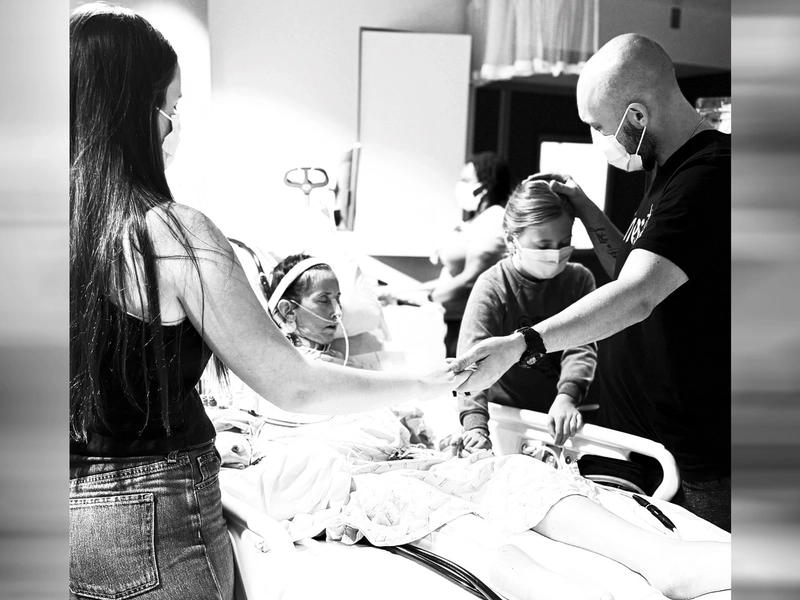
The doctors came to me and said that we had one shot, a “Hail Mary.” They told me she would need surgery to find the leak and close it. The odds weren't good. They weren't telling me that to discourage me, they were telling me the truth.
I called my family and had the kids brought up to the hospital.
I wanted them to be able to say what they needed to say to their mom. Just in case. I don't have words for what that was like. I don't think I ever will.
Eight hours later, she came out of surgery. They found the leak. They closed it. She made it.
Because Melissa has had so many blood products throughout her life, she had too many antibodies. Her care team worked to knock down her immune system, washing out as many antibodies as they could from her blood, trying to improve the odds that her body wouldn't reject a donor heart.
We were told that a heart transplant match would be extremely difficult to find. They got her on the list but said if we don't find a match within a few days, we would need to move forward with an LVAD, a left ventricular assist device. Much like a balloon pump, the LVAD is a surgically implanted pump to assist her failing heart as a bridge-to-transplant treatment.
Dan Meyer, MD, chief of heart transplantation and advanced circulatory support at Baylor University Medical Center, performed the surgery. It was longer than most, as Melissa is a small person, and finding a way to tuck it in took precision. But after the LVAD was placed, it was discovered that the right side of her heart wouldn't wake up.
They moved her immediately to extra corporeal membrane oxygenation (ECMO). This machine replaces the function of the heart and lungs. Her blood was leaving her body through lines in her neck the size of a garden hose, going down to a machine on the floor and coming back. The right side of her heart still wouldn't respond.
In the middle of everything, during a CT scan, the ECMO machine failed. The lines, and Melissa’s blood, stopped moving and stood still. At that point, there was no way to put her back on it—there were no available sites in her chest or neck left for another insertion.
Another miracle occurred. Melissa’s heart stood on its own for 20 hours before she was hooked back up to a new ECMO machine. No support. No explanation. It just stood up.
As all of this was happening, we knew what it meant. It's a heart, or it's nothing.
“You want a heart?”
A few days later, while we were still knocking down Melissa’s immune system and still waiting for a heart, my kids, my mom and my dad gathered in her room. My daughter played guitar and sang. My youngest did drawings. We prayed together. Just a family, doing what families do, refusing to give in to the weight of all that was happening.
As my kids were walking out of the room, a doctor I'd never seen before walked in. He stood at the foot of Melissa's bed.
"Are you ready for your heart transplant? You want a heart?" he said. And then he walked out.
I stood there. I couldn't process it. And then it hit me: we just got a heart. The impossible of impossibles.
That’s when our family was introduced to Aldo Rafael, MD, a cardiac and heart transplant surgeon at Baylor University Medical Center.
September 12, 2025: “We’re moving forward”
At 6:30 AM, they started prepping Melissa for surgery. They took her down to the operating room and Dr. Rafael examined the donor heart.
And then I got a text, THE text: "We're moving forward."
I knew in that moment she was going to make it. Not because I was naive about the risks. I knew exactly what the risks were. I had been living them for months. But I had walked with God too long to stop believing now. He had not brought us this far to drop us on our heads.
Dr. Rafael and Dr. Meyer, along with an incredible support team, performed Melissa’s heart transplant. It was deemed a success.
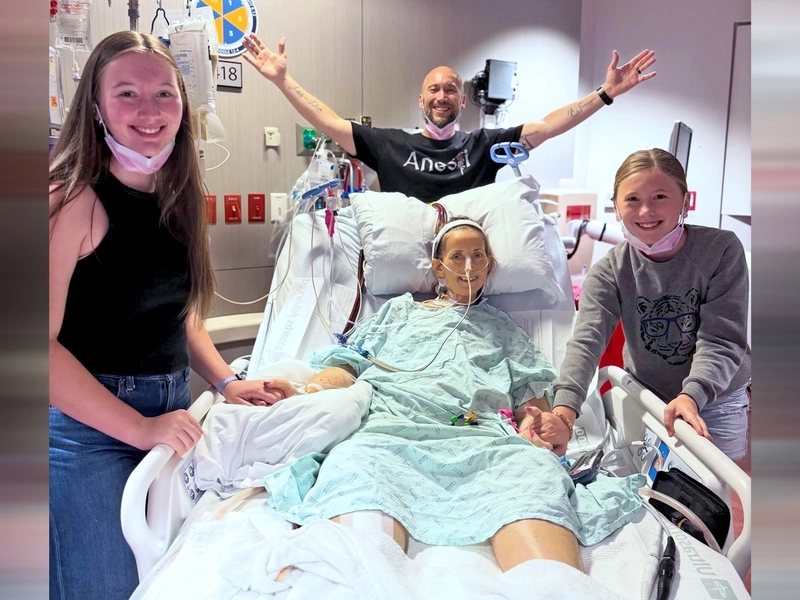
Post-heart transplant, the recovery continues
Nobody said recovery after a heart transplant would be easy. Forty-eight hours after the transplant, Melissa developed pneumonia. Already immunocompromised, she went on a ventilator for weeks. Her liver was inflamed and her kidneys were still offline.
Then they found something on a scan, a growth inside the new heart. Something calcified, not just on the valve but inside the heart itself. We watched it. We prayed. We waited.
A few days later, the doctor looked at a new scan and the growth was gone. Nowhere to be seen. Another miracle for Melissa.
The days after continued to be tough. Through all of it, Melissa never said no to physical therapy. Never said no to occupational therapy. Even on a ventilator in the CVICU with tears running down her face, she got out of bed to walk, refusing to quit.
There are so many people I could name that I want to thank for their role in this journey. So many nurses, doctors and support staff who didn't just do a job; they went to war for us. They made game-changing decisions. They took game-changing actions. I am forever changed because of those people.
There’s no place like home
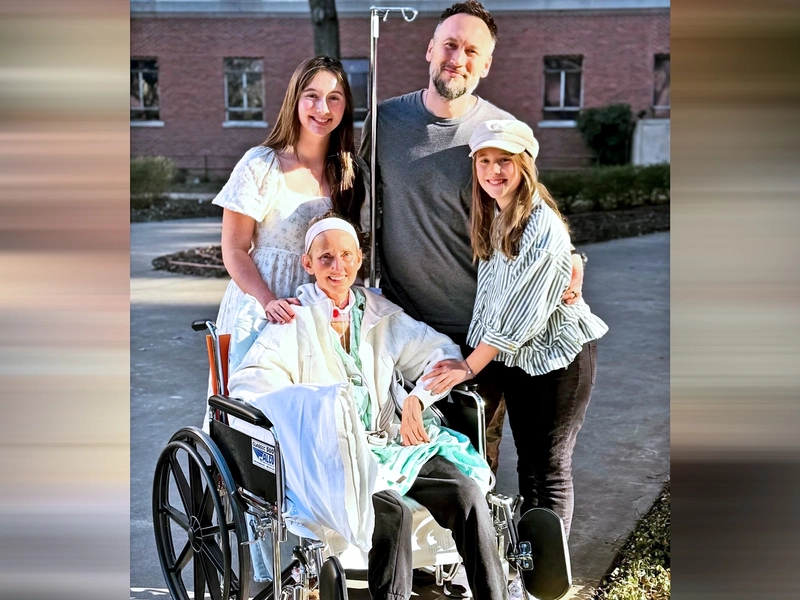
Melissa was eventually moved out of the CVICU to a regular room and then to a rehab facility in February 2026. She came home on April 2, 2026.
Today, Melissa’s still in active recovery. She's quite thin. She goes to dialysis three days a week to help her kidneys. She has a walker and a wheelchair. She's on a lot of medications. But she is gaining strength every single day. And the medicine of being at home, well, there's nothing like it.
Standing on her own two feet
What helped push Melissa further in her recovery was something I never expected, a robotic exoskeleton.
Baylor Scott & White Health is running one of the first clinical trials in the country, called the REACT trial, using this technology on people who have undergone heart and lung surgeries. Dr. Meyer, who has been such an instrumental part of our journey to receiving a new heart, is leading this trial. It was originally built for people with spinal cord injuries, and now they're testing it on people like Melissa, who are critically ill and trying to remember how to move.
When you've been in bed as long as Melissa was, everything starts to fail. Walking is a basic, human movement and when you stop doing it, your digestive system slows, your lymphatic system stalls and your vascular system suffers.
But the moment I'll never forget is when she stood up in the exoskeleton, and she hugged me. She cried, and I'm not ashamed to say I did too.
That machine didn't just help her walk. It is helping her learn how to stand on her own two feet again.
Melissa will start cardiac rehabilitation when she's strong enough. She will keep going. I have zero doubt.
What I know now
I know what it means to be a caregiver now in a way I didn't before. It is the hardest thing I have ever done. It is also the most important. The staff at Baylor Scott & White didn't treat me like an outsider, in fact, they treated me like a vital part of the care team. They listened to me, understanding that I know Melissa better than anyone else in that building.
I also know now that you cannot offload your health, or the health of a loved one, to the medical system and walk away. You have to be involved. You have to ask questions. You have to show up as a partner in the process, not a passenger.
I know that words matter in a hospital room. We refused negativity. We refused to imagine anything less than total victory. We wouldn't even let ourselves picture walking out of there with anything other than Melissa whole and alive. That is a choice. Every single day, it is a choice.
And I know miracles are real.
I've watched them happen:
- In a pregnancy that defied anatomy
- In feet that should have been lost but weren't
- In a heart that stood up on its own for 20 hours
- In a growth that appeared and then vanished
- In a donor heart that came through at the eleventh hour
Melissa is 41 years old. She's home. She's still fighting. She's alive.
We are thankful for where we are today and the care that helped make it possible. And Baylor Scott & White has forever changed our lives.
Learn more about how Baylor Scott & White Health’s transplant services are impacting people like Melissa and Gabriel.